

What is cryogenic storage? The foundation protecting biological samples for Cell Therapy, Biobanks, and IVF
A cryogenic storage tank may look like a simple piece of preservation equipment. But what it holds can be irreplaceable biological assets: a line of CAR-T cells for personalized treatment, biological samples from a tissue bank or an IVF center, or the outcome of years of scientific research. This article explains what Cryogenic Storage is, how it works, and the criteria a system needs to meet GMP and AABB standards.
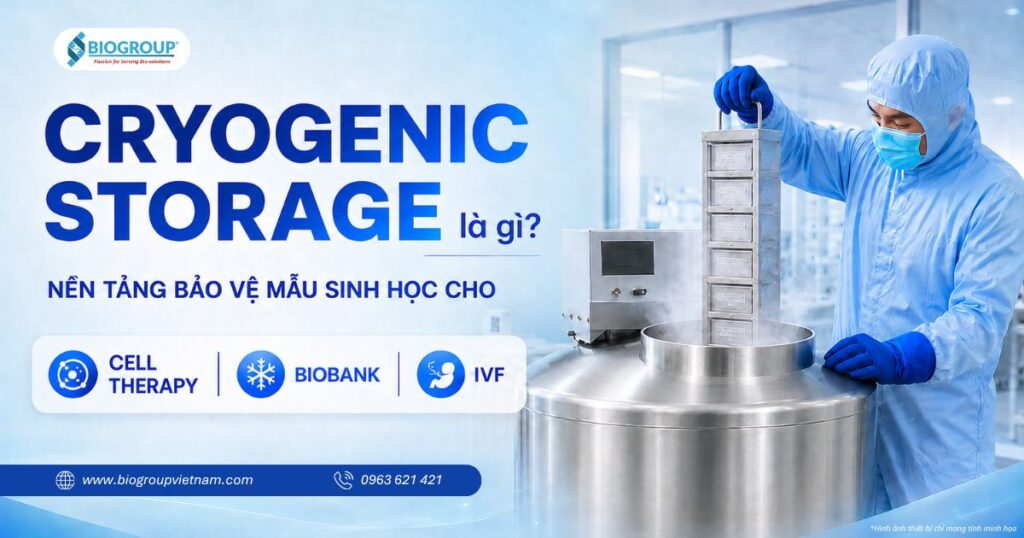
Cryogenic Storage is the foundation protecting biological samples for Cell Therapy, Biobanks, and IVF
Over more than two decades, the growth of Cell Therapy, Gene Therapy, Regenerative Medicine, IVF, Biobanking, and Precision Medicine has elevated the role of cryogenic (deep-freeze) storage systems. It was once seen simply as a place to “keep samples.” Today, it is critical infrastructure that directly affects sample quality, research continuity, patients’ access to treatment, compliance with GMP/AABB/FACT/ISO, and the credibility of the storing organization.
A stem cell sample that loses viability after years in storage causes more than financial loss. It can mean a treatment course that can no longer continue, a research direction that must start over, and serious damage to an organization’s reputation. For hospitals, fertility centers, tissue banks, or research institutes, a storage failure can also erode the trust of customers and partners, affecting brand image and competitive standing. This is why Cryogenic Storage needs to be built as a biological asset management system, not a single piece of equipment.
What is Cryogenic Storage?
Cryogenic Storage (deep-freeze storage, or ultra-low-temperature storage) is a method of preserving biological samples at extremely low temperatures to bring cellular biological and metabolic activity to a near-complete halt. Most facilities use liquid nitrogen (LN₂) at around −196°C for long-term storage. Multiple industry references, including a summary of AABB (Americord Registry, 2026), confirm the requirement to store stem cells in liquid nitrogen at −196°C with continuous temperature monitoring and alerting.
Sample types commonly preserved through Cryogenic Storage include:
- Stem cells: MSC, HSC, iPSC
- Immunotherapy products: CAR-T, NK cells
- PBMC (peripheral blood mononuclear cells)
- Embryos, sperm, and oocytes for IVF
- Cord blood and biological tissue
- DNA, RNA, microorganisms, industrial strain cultures
- Vaccines, reference virus strains, research proteins
Learn more: Why do cells need to be stored below −150°C?
Why has cryogenic storage become the foundation of regenerative medicine?
In Cell Therapy, every stored sample can carry irreplaceable value: a batch of CAR-T cells for personalized treatment, an iPSC line developed over many years, a cord blood sample that can only be collected once, or an IVF embryo bank belonging to multiple families. These samples cannot be “redone” if lost, so the goal of Cryogenic Storage goes beyond maintaining a low temperature. It must also ensure sample integrity, traceability, a continuous chain of monitoring, incident-response capability, and regulatory compliance.
The principle behind Cryogenic Storage
At extremely low temperatures, most enzymatic and metabolic cell activity comes to a near standstill, which helps preserve cell structure, maintain DNA and RNA, slow biological aging, and sustain post-thaw viability. Based on guidance from the FDA (U.S. Food and Drug Administration),
the recommended long-term storage threshold is a maximum of −150°C to ensure stable performance after thawing. This is why most modern cryobanks target this threshold rather than relying solely on −80°C freezers, which are only suitable for short- to medium-term storage.
Two common cryogenic storage methods
Liquid Phase Storage
Samples are submerged directly in liquid nitrogen. Advantages include even temperature distribution, fast cooling, and lower operating cost. Limitation: if packaging is inadequate, there is a risk of cross-contamination through shared liquid nitrogen.
Vapor Phase Storage
Samples sit above the liquid nitrogen surface, typically at temperatures below −150°C. Advantages include a lower cross-contamination risk, better alignment with GMP requirements in Cell Therapy, and it is the method chosen by many modern biobanks. Limitation: it requires a tank capable of maintaining a stable cold-vapor zone and an optimized design.
| Criterion | Liquid Phase | Vapor Phase |
| Standard temperature | -196°C | ≤ -150°C |
| Cross-contamination risk | Higher if packaging is not sealed | Lower |
| GMP fit for Cell Therapy | Requires tight packaging control | Preferred |
| LN₂ operating cost | Lower | Relatively higher |
See also: Should you choose a vapor-phase or liquid-phase storage tank?
What makes up a complete cryogenic storage system?
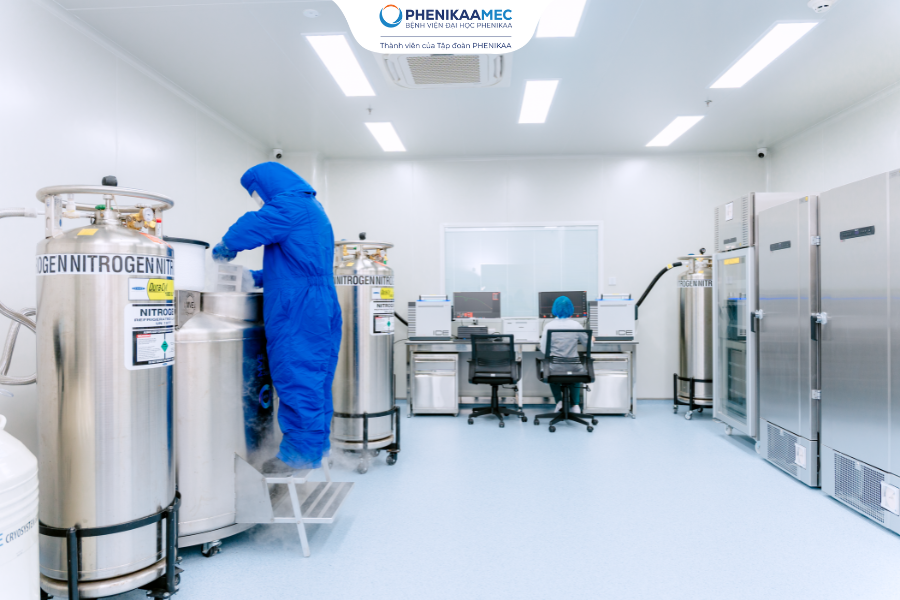
The deep-freeze storage system at the Phenikaa Tissue Bank is monitored 24/7 (Source: Suc Khoe va Doi Song — Phenikaa Mec Stem Cell Center and Tissue Bank approved by the Department of Health to roll out 28 additional techniques)
Many organizations focus only on selecting a storage tank, while a complete system requires several interconnected components.
1. Cryogenic Storage Tank
This is the center of the entire system. A quality tank needs a stable vacuum, durable materials, good insulation, low LN₂ consumption, a long service life, and the ability to protect samples during a power outage. For Cell Therapy or biobank centers, this is a long-term investment that can operate for decades if properly maintained.
2. Cryogenic Accessories and Inventory System
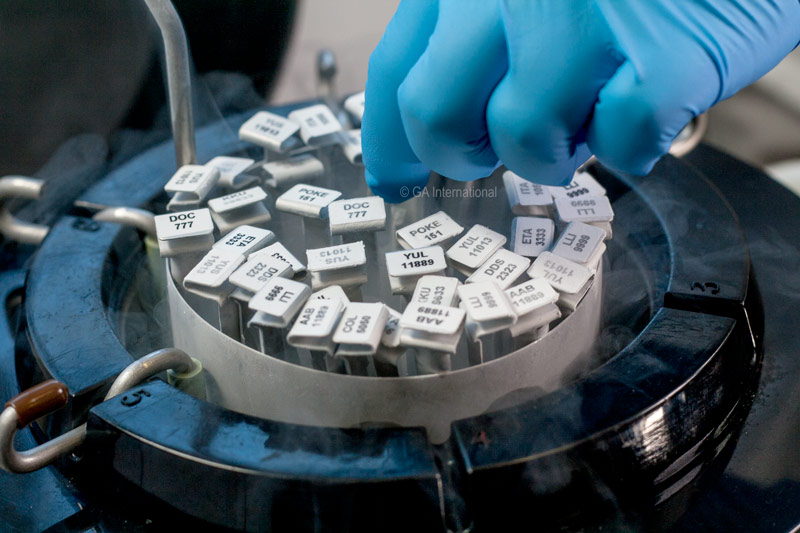
Canisters holding cryocanes inside a deep-freeze storage tank, identified with barcode/cryovial labels (Source: GA Lab Tag)
Sample-location management needs to be standardized. Under supplementary guidance from ISBER (Fourth Edition Addendum, summarized via Labtag), each sample should carry a unique identifier linked to an electronic inventory system, using barcodes or RFID, along with a consistent numbering convention for racks, shelves, and boxes. This approach helps samples be located faster, reduces lid-opening time, reduces nitrogen loss, and lowers the risk of sample mix-ups.
3. Monitoring System
Parameters that require continuous monitoring include temperature, LN₂ level, alarm status, vacuum integrity, lid-open status, power supply, and room oxygen concentration. The system should send multi-channel alerts and integrate Auto-Fill for automatic LN₂ replenishment: SMS, email, mobile app, and SCADA/BMS integration where possible.
4. Oxygen Monitoring
Evaporating liquid nitrogen can lower oxygen concentration in an enclosed room. According to technical analysis from Consarctic (2026), one liter of evaporated liquid nitrogen produces roughly 700 liters of nitrogen gas at room temperature; normal atmospheric oxygen concentration is about 20.9%, early symptoms (dizziness, headache, disorientation) appear once concentration drops below 18%, and the risk of loss of consciousness rises sharply below 10%. Cryogenic Storage rooms therefore require fixed O₂ sensors, ventilation systems, and audible and visual alarms — this is a mandatory safety requirement for staff, not an optional item.
5. SOPs and Operating Procedures
Even a modern system can carry risk without proper procedures. A cryobank needs SOPs for sample intake, storage, retrieval, LN₂ replenishment, alarm response, emergencies, and maintenance.
The biggest risks in cryogenic storage
Vacuum degradation
The vacuum layer determines the tank’s insulating capacity. As vacuum quality degrades, LN₂ consumption rises, temperature becomes unstable, tank lifespan shortens, and the risk to samples increases accordingly. Periodic inspection and tracking of LN₂ consumption trends over time are essential.
LN₂ shortage
Without a timely replenishment plan, temperature rises, samples are affected, and in the worst case an entire biological bank can be lost.
Sudden power loss
The LN₂ tank itself does not depend on electricity, but the alarm system, monitoring, BMS, and Auto-Fill can all be interrupted without a backup power source.
The human factor
Many operational incidents stem from leaving lids open too long, retrieving the wrong sample, mislabeling, incomplete data entry, or failing to replenish LN₂ on schedule. This is why training, SOPs, and digital systems need to work together.
In practice, the greatest risk rarely comes from the liquid nitrogen itself, but from gaps in monitoring and contingency procedures. A risk- and quality-management analysis for assisted reproduction (ART) labs, published on PMC/NCBI, found that a new tank can fail to hold temperature for more than 24 hours if a fault occurs alongside insufficient monitoring, alerting, maintenance, and timely inspection, while an older tank that has been well maintained can still meet storage requirements reliably. That gap is closed only through continuous risk- and quality-management practices, not through equipment quality alone.
The international IVF industry has recorded large-scale sample-loss incidents involving storage tanks, reported by major outlets such as NBC News in 2018 in the United States. According to these reports, the incidents were linked to remote alarm systems that failed to respond in time as LN₂ levels dropped. Incidents like these show that relying on a single layer of alerting is not enough; independent backup monitoring, periodic inspection, and response procedures are needed to reduce the risk of sample loss.
See also: Why is temperature stability the key factor for maintaining sample viability in Cryogenic Storage?
Cryogenic Storage within the GMP, AABB, FACT, and ISO compliance framework
A compliant system must demonstrate process control, not just adequate equipment. The FACT (Foundation for the Accreditation of Cellular Therapy) standard, specifically under section C7.5.2, requires continuous temperature monitoring inside the transport container or the storage-area environment. Factors typically assessed in a GMP/AABB/FACT audit include:
- Sample traceability
- Operating records and LN₂ replenishment logs
- Maintenance records and alarm logs
- Access control and change management
- Risk assessment and contingency planning
- Periodic staff training
To standardize these items into an auditable process, many cryobanks use an AABB/FACT-compliant cryobank operating SOP checklist as a starting point.
When investing, purchase price alone should not be the deciding factor. A system needs to be evaluated across its entire operating lifecycle.
| Criterion | Significance |
| Vacuum durability | Determines insulation performance and tank lifespan |
| LN₂ consumption rate | Directly affects operating cost (TCO) |
| Temperature stability | Protects sample quality over the long term |
| Storage capacity | Meets current needs and future expansion |
| Monitoring system | Continuous tracking, early warning of anomalies |
| Technical service | Maintenance, calibration, and rapid incident support |
| Scalability | Easy integration of additional tanks, Auto-Fill, management software, or centralized monitoring |
For facilities pursuing GMP or AABB compliance, choosing a supplier capable of designing a complete solution and providing support throughout the project lifecycle typically delivers better results than purchasing a single standalone device.
The future of cryogenic storage
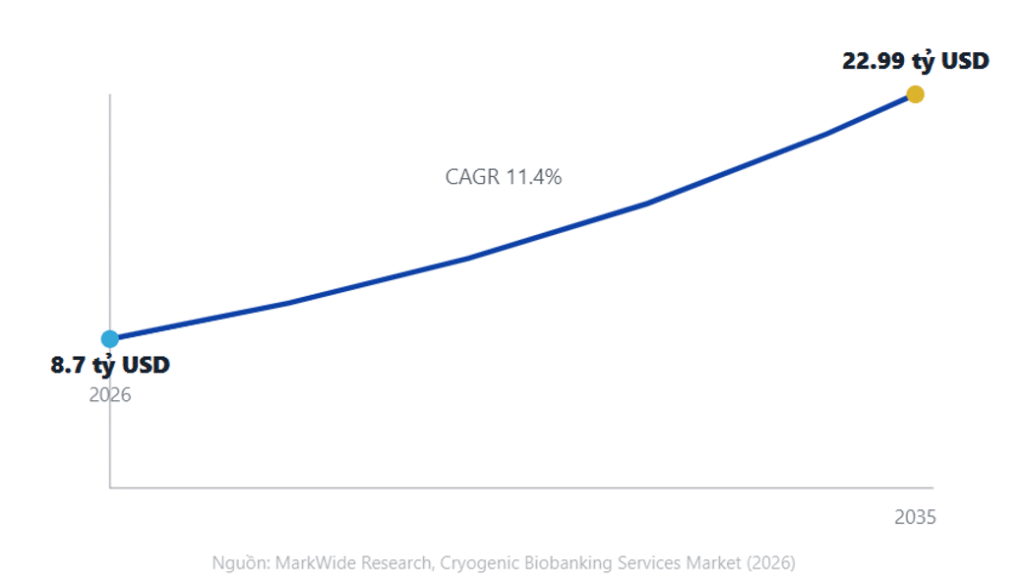
The global cryogenic biobanking services market is projected to nearly triple between 2026 and 2035. (Source: MarkWide Research (2026))
Modern cryobanks are shifting from manual storage models toward a digitally monitored storage ecosystem, with notable trends including: real-time remote monitoring, centralized data management and electronic traceability, integration with LIMS/MES/BMS, multi-channel alerting, LN₂ consumption trend analysis for predictive maintenance, and support for electronic data requirements in GMP environments.
With market growth in the double digits, the pace of operational capacity expansion, especially trained cryostorage personnel, is often the most overlooked factor in developing biobanking markets such as Vietnam. This further reinforces the role of standardized SOPs and digital monitoring as a mandatory part of the system, not something to be added later.
Frequently asked questions
How does Cryogenic Storage differ from a −80°C freezer?
A −80°C (ULT) freezer suits short- to medium-term storage, or cell types that remain stable at this temperature. Cryogenic Storage using liquid nitrogen reaches ≤ −150°C to −196°C, suitable for long-term storage (from several years to several decades) for sensitive samples such as stem cells, embryos, or Cell Therapy products.
Is oxygen monitoring mandatory in a Cryogenic Storage room?
Yes. Because evaporating liquid nitrogen can quickly lower oxygen concentration in an enclosed space to dangerous levels, storage rooms need fixed oxygen sensors, adequate ventilation, and audible/visual alerts. This is an occupational safety requirement, not an option.
What does Cryogenic Storage’s operating cost include?
Beyond the initial tank purchase, total cost of ownership (TCO) includes: periodic LN₂ consumption, maintenance and calibration, monitoring/inventory software, staff training, and replacement cost once a tank reaches end of life (typically after many years of operation, depending on vacuum quality)
Conclusion
Cryogenic Storage is not simply a liquid nitrogen container. It is a system that protects high-value biological assets, where every decision on design, equipment selection, operating procedures, and monitoring directly affects sample quality, patient safety, and organizational credibility.
For Cell Therapy centers, biobanks, IVF clinics, CDMOs, and hospitals pursuing GMP or AABB standards, investing in Cryogenic Storage should be viewed as a long-term strategy: not just owning high-quality equipment, but building a complete ecosystem of equipment, management software, monitoring systems, standardized procedures, and professional technical service. A solution designed correctly from the outset lowers total cost of ownership (TCO), increases sample safety, and provides a solid foundation for research and treatment programs in the years ahead.
| Are you building or upgrading a Cryogenic Storage system for Cell Therapy, Biobank, or IVF? Biogroup Vietnam’s team of experts can support you from on-site assessment and design consulting, to equipment configuration, SOP development, monitoring-system deployment, operator training, and periodic maintenance service. 📩 Contact us for a consultation
|
REFERENCES
- Americord Registry. (2026a). AABB accreditation process explained. https://www.americordblood.com/articles/aabb-accreditation-process-explained
- Americord Registry. (2026b). Temperature guidelines for stem cell transport. https://www.americordblood.com/articles/temperature-guidelines-for-stem-cell-transport
- Consarctic. (2026). Oxygen deficiency detector: Cryogenic laboratory safety. https://www.consarctic.com/en/post/oxygen-deficiency-detector-cryogenic-laboratory-safety
- Gardella, R., & Edwards, E. (2019, March 4). Heartbreak, anxiety, lawsuits: The egg-freezing disaster a year later. NBC News. https://www.nbcnews.com/news/all/heartbreak-anxiety-lawsuits-egg-freezing-disaster-year-later-n978891
- Goldberg, A. (n.d.). Recommendations by ISBER for cryogenic sample storage & biobanking. GA International LabTag. https://blog.labtag.com/recommendations-by-isber-for-cryogenic-sample-storage-biobanking/
- IndexBox. (2026). Cryogenic storage dewar market forecast points higher toward 2035, driven by biobanking expansion and automated monitoring adoption. https://www.indexbox.io/blog/cryogenic-storage-dewar-market-forecast-points-higher-toward-2035-driven-by-biobanking-expansion-and-automated-monitoring-adoption/
- MarkWide Research. (2026). Cryogenic biobanking services market. https://markwideresearch.com/cryogenic-biobanking-services-market
- Schiewe, M. C., Freeman, M., Whitney, J. B., VerMilyea, M. D., Jones, A., Aguirre, M., Leisinger, C., Adaniya, G., Synder, N., Chilton, R., & Behnke, E. J. (2019). Comprehensive assessment of cryogenic storage risk and quality management concerns: Best practice guidelines for ART labs. Journal of Assisted Reproduction and Genetics, 36(1), 5–14. https://doi.org/10.1007/s10815-018-1310-6
- U.S. Food and Drug Administration. (2014). Biologics license applications for minimally manipulated, unrelated allogeneic placental/umbilical cord blood intended for hematopoietic and immunologic reconstitution in patients with disorders affecting the hematopoietic system: Guidance for industry. U.S. Department of Health and Human Services. https://www.fda.gov/media/86387/download
- Veritas Innovation. (2025). Storage temperature stability of therapeutic cell types. https://www.veritasinnovation.com/blog-veritas/storage-temperature-stability-of-therapeutic-cell-types



![[Checklist] Lựa chọn hệ thống Lưu trữ Lạnh sâu (Cryogenic Storage) cho phòng thí nghiệm](https://biogroupvietnam.com/wp-content/uploads/2026/08/checklist-lua-chon-he-thong-luu-tru-lanh-sau-cryogenic-storage-cho-phong-thi-nghiem-lab-4-3-200x150.png)
